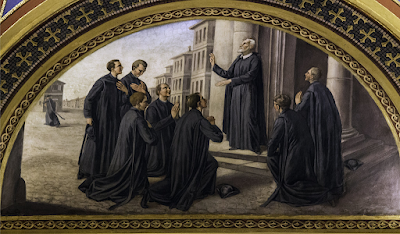
Showing posts with label Life of St. Philip. Show all posts

Monday, January 20, 2025

Dr. Mahrt's Requiem at the Mission Dolores

On Thursday, January 10, one of the Brothers and a postulant drove up north to sing for the Solemn High Requiem of Dr. William Peter Mahrt, president of the Church Music Association of America (CMAA) and a publisher for New Liturgical Movement. The Requiem took place in the basilica church of the Mission Dolores (Misión San Francisco de Asís), adjacent to the much older 1776 adobe chapel originally used by Franciscan missionaries. Mary Ann Carr-Wilson, who in the past has collaborated frequently with the Brothers, was one of the singers our envoys recognized at the Requiem. Many of the others who sang for the funeral were students of Dr. Mahrt while he taught at Stanford University. Two obituaries; a sermon from His Excellency the Most Reverend Msgr. Salvatore Cordileone, Archbishop of San Francisco, who preached before the absolution; and other related articles are available in the links below.


All who served the Mass that day (MC, crucifer, etc.) appeared to be priests. Two deacons sat in choro alongside Abp. Cordileone in choir dress, Fr. Joseph Illo of Star of the Sea Church, a Norbertine from St. Michael's Abbey, a Dominican friar, and other clerics. Another elderly Dominican friar sat in the nave of the basilica with a walker. The vestment set worn included a Neri-style chasuble.


Some Photos from Karolina Zapolska

The full photo album from Dr. Mahrt's funeral can be viewed at the bottom of the CMAA obituary, as well as on CMAA's Facebook.


Photos from the Mission Complex

The following photos were taken in various parts of the Mission complex before the Mass. Aside from the basilica church and the chapel, the complex also includes a museum and a cemetery. The cemetery's burials include Costanoan Indians converted by the Franciscans, Spanish colonial officials, as well as American-era Irish and Italian settlers.


A replica Costanoan hut

Grave of two baptized Costonoans


A bugia

Preparations for Mass


A kneeler used by JP2

Side altar of the adobe chapel

Our Lady of Refuge,
Patroness of California


A reliquary of St. Junipero Serra


Singing Materials and Dr. Mahrt's Favorite Motets List

At the funeral reception, some of the singers joined in singing Dr. Mahrt's favorite motets, which are listed below: 
  • Caeleste beneficium (Jean Mouton)
  • Sicut cervus (Palestrina)
  • O magnum mysterium (Victoria)
  • O Salutaris Hostia (La Rue)
  • Christum ducem (Josquin des Prez)


The program for the Mass and other printed materials can also be found in the photos above. Helen Waddell's (d. 1965) English translation of a hymn from Prudentius, the Roman Christian poet who wrote Corde natus, was included at the end of the Mass booklet. In fact, it is listed as Hymn X in the Liber Cathemerinon, immediately after Hymn IX, Corde natus. The original Latin text and the English text from the booklet can be found in the links below.


A Quote from St. Philip


"If God be with us, there is no one else left to fear."

From the January 10 entry of
the Maxims and Sayings of St. Philip Neri

Translated by the Rev. Fr. F.W. Faber, Cong. Orat.

Requiescat in pace.

Wednesday, December 25, 2024

A Christmas Message from St. Philip

The crèche at the London Oratory, 2024


"Let us reflect that the Word left heaven, 
and stooped to become man for us."


Translated by the Rev. Fr. F.W. Faber


He was in the world, and the world was made by him, and the world knew him not. He came unto his own, and his own received him not. But as many as received him, he gave them power to be made the sons of God, to them that believe in his name. Who are born, not of blood, nor of the will of the flesh, nor of the will of man, but of God. AND THE WORD WAS MADE FLESH, and dwelt among us, (and we saw his glory, the glory as it were of the only begotten of the Father,) full of grace and truth.

Excerpt from the Gospel of the 
Third Mass of Christmas (the daytime Mass),
the introduction of St. John's Gospel, 
also known as the Last Gospel, 
read at the end of nearly all traditional Masses.


Merry Christmas!
From the Brothers of the Little Oratory in San Diego
and Chorus Breviarii

A.D. 2024

Friday, September 27, 2024

A Recently Painted St. Philip Statuette

During his visit to London around St. Philip's Day this past spring, Frater David Latorre purchased a statuette of St. Philip at the Oratory gift shop. As can be seen in the photo below, it initially came unpainted. As Fratellino pointed out, besides some details in the cassock, this gift shop statuette is a very faithful depiction of St. Philip. Paintwork was done by a friend of Frater Roberto Lionello and his wife Grace.


During our usual conclusion of Monday night practice with Compline, Frater David placed the statuette on the mantle next to the crucifix. This recently painted statuette makes a wonderful addition to the Brothers' devotional objects, and it was recommended to the San Diego Brothers' current postulants that they themselves should obtain something similar during their visit to London for admissions.


(Courtesy: David)

Friday, May 17, 2024

Novena to St. Philip 2024


The Novena to St. Philip in anticipation of his feast begins today.

We here in San Diego use the version provided on Liturgia Latina linked below.

Novena of St. Philip Neri by St. John Henry Cardinal Newman


Note that because the normal date for Philipmas coincides with Trinity Sunday this year, the various Oratories will be celebrating his solemnities on May 27, rather than May 26.

Wednesday, May 8, 2024

Throwback to a 2008 San Diego Brother

Those who keep up with New Liturgical Movement may have seen that our Brother Robert Keim has been welcomed as a new member of NLM's writing staff. Congratulations to him!

Frater Robert was part of the group of Brothers admitted to the Oratory in 2008, the others being the late John J. Velasco, his son Christopher, Wayne Lam, Richard Dawes, and George Pecoraro. 

Frater Robert reading from
Fr. Bacci's life of St. Philip in a
 Precious Blood robe.

It seems that all our articles that mention him are nearly 15 years old or older! There are some great photos included, so we encourage you to take a look.
Additionally, Frater Robert accompanied Fratellino and Frater Richard to sing for a Solemn High Mass in Orange County over a decade ago.

St. John the Evangelist, Costa Mesa, 2013

For those interested in Mr. Keim's first few articles from New Liturgical Movement, we have them linked below.

Additionally, he is one of the twenty-six authors included in Dr. Peter Kwasniewski's book Ultramontanism and Tradition: The Role of Papal Authority in the Catholic Faith, with some of the other authors including Cardinal Burke, Bishop Schneider, and Dr. Joseph Shaw of the Latin Mass Society, as well as fellow Southern Californians Dr. Ed Feser and Charles A. Coulombe. Dr. Kwasniewski has information on the book here.

Saturday, March 16, 2024

The Lenten Miracle of St. Philip

St. Philip hears the last Confession of the
resurrected Paolo before the boy returns to eternal sleep.

This past Thursday, the Lesson of the day's Lenten ferial Mass recounted the Prophet Elisha's raising of the Sunamite woman's son from the dead. The Gospel of the same Mass recounts the raising of the widow of Naim's son. These two lessons are reused today for a special feast of the Oratory commemorating St. Philip's raising of Paolo Massimo from the dead on March 16, 1583. New Liturgical Movement has an article discussing the miracle commemorated by this feast, as well as the other Mass Propers (which differ from the Lenten feria).


From Fratellino:

Today is the anniversary of St. Philip's miraculous raising of young Paolo Massimo from the dead. Masses will be said by numerous prelates at the altar in the Palazzo Massimo in Rome, which is opened annually for this purpose. S. Philippo Neri, ora pro nobis! 


The photos are from Andrew Wilce on Facebook. We encourage you to read his post recounting the awesome miracle that God brought through Good St. Philip!

Wednesday, February 28, 2024

The Little Oratory, Can't Vote

Image of St. Philip posted by Marlon.
Probably from the Pharr Oratory.

The Manual of the Little Oratory, the websites of various Oratories around the United States, and the Constitutions of the Oratory make it clear that voting is a normal aspect of Oratorian life. I realized recently that it was a bit ironic that the newest Oratory of Pontifical Right to be established is located in Washington, D.C., a part of the United States well-known for its inability to vote for Congressional representatives in the House or Senate (thankfully). In a discussion I had with Fratellino about what the acrostic for the D.C. Oratory's version of "True Sons of Philip" should spell out, I suggested The Little Oratory, Columbia. On the other hand, Fratellino suggested the much more humourous The Little Oratory, Can't Vote. Taking Fratellino's concept, here is one suggestion.

True sons of Philip, raise

Heav’nward your strain of praise,

Ever rejoicing in God, as he taught;

Learn from St Philip still

In body, mind and will

Truly our Lord to serve, counting self as naught.

Songs therefore let us bring,

Praises to Jesus sing,

Now and for ever our Lord and our God. (2)

Trust in St Philip’s prayers,

Let him relieve our cares,

Ease for us gain in temptation and stress.

Once we his aid invoke

Riven is Satan’s yoke

And we are stronger our Saviour to bless.

(Refrain)

Turn, as St Philip bade,

Often to Mary’s aid,

Refuge and help she refuses to none;

Years have not dimmed her power

Come now and ev’ry hour

All grace she wins us by prayer with her Son.

(Refrain)

Never shall we despair

Triumphant, we declare

Victory over sin with the Spirit's love;

Out with all sadness here,

Take on St. Philip’s cheer

Evermore till we rule with the Saints above!

(Refrain)


The lines for "C" and "A" in the third verse are identical to the Cardiff Oratory's acrostic, while the "O" in the final verse is identical to the one found in Oxford's acrostic. We here in San Diego certainly look forward to whatever D.C. decides to write for their version of this great Oratorian hymn, but I hope they enjoy our rendition as well!

As the Cardiff Oratory explains, the hymn was originally written as an acrostic, spelling out The Little Oratory in London. Adaptations for each Oratorian House in Britain modify the last eight lines of the song (i.e., the last third of the third verse and the whole six lines of the fourth verse). The refrain acrostic spells out S.P.N. (St. Philip Neri). 

At Cardiff, these last eight lines spell out Caerdydd (the Welsh name for the city), while Oxford's lines spell out in Oxford. The verse-writer at Oxford dealt with the difficulty of the letter "X" by referring to St. Francis Xavier, one of St. Philip's role models (as well as one of the four Spaniards he shares his canonization date with). Since the Brothers in San Diego were received into St. Philip's family at London, Chorus Breviarii is accustomed to singing the original in London version. However, somewhere in Fratellino's archives, there may still exist a copy of an acrostic for San Diego written over a decade ago. 


Now, we ought to charge Marlon with writing one for Pharr if they develop a sizeable Little Oratory out in Texas.

Wednesday, February 14, 2024

Some Penitential Sayings of St. Philip

At the start of Lent, let us remember some sayings from the Good Saint that put us in a penitential spirit.


Two sayings to especially remember on Ash Wednesday (February 16 & 17)

"There is nothing good in this world: Vanitas vanitatum, et omnia vanitas."

"We must die at last."

St. Philip hearing confessions

A saying to keep in mind for confession and a holy life (February 13)

"Let a man frequent the holy Sacraments, go to sermons, and be often reading the Lives of Saints."


A saying on occasions of sin (February 15)

"When a man is in an occasion of sin, let him look what he is doing, get himself out of the occasion, and avoid the sin."


A saying to counter Adam's attempt to hide in the Garden (February 14)

"Let a man always think that he has God before his eyes."

Thursday, December 28, 2023

St. Philip, Childermas, and the English Martyrs

Merry Christmas to all!

Today begins the Childermas Octave ("childer" being an archaic form of "child" and a cognate of the German word "kinder"), commemorating the martyrdom of the Holy Innocents. Cardinal Gasquet wrote about how St. Philip used to greet the students of the Venerable English College in Rome with the first line of the Lauds hymn of the Holy Innocents, Salvete flores martyrum ("Hail ye flowers of the martyrs!"). This was of course referencing the sweet fate of many English priests, who obtained the martyr's crown during the persecutions in Elizabethan England.

Proud indeed must be every son of the Roman Alma Mater at the thought of the heroic sufferings and deaths of so many of the old students of the Venerabile, and of the fact that the very foundations of the College were washed, as it were, by the blood of the many martyrs who went forth as priests from its walls to help to preserve the Catholic religion in England. They were true heroes in every sense of the word, knowing as they did that they were preparing themselves in their college life for certain persecution and possible death, in the exercise of their ministry in England. This is why the sweet St. Philip, who lived close to the College, on meeting them in the streets was wont to salute them with the words of the hymn for the feast of the Holy Innocents, Salvete Flores Martyrum.

Monday, October 9, 2023

Two Saintly Friends of St. Philip

Today, October 9, marks the feast days of St. John Henry Newman and St. John Leonardi. Though they lived nearly three centuries apart, St. John Henry Newman and St. John Leonardi both came to know St. Philip Neri during their lifetimes. The former knew St. Philip through joining the Oratory following his conversion, while the latter knew St. Philip as a fellow counter-reformer and his own spiritual director.
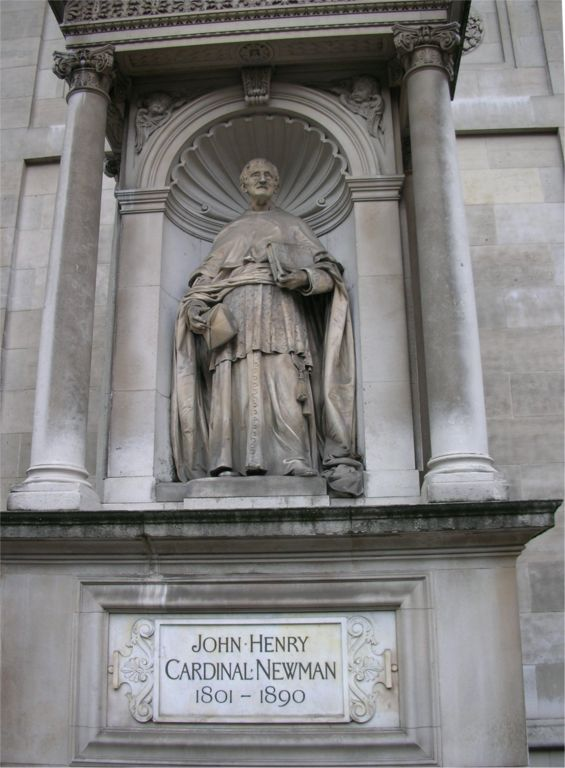
At the Brompton Oratory

After years of defending the High Church position within Anglicanism, Newman became wholly convinced of the truth of the Catholic faith, especially in the face of the Church of England's questionable alliances with explicitly Protestant church bodies. Through the Passionist priest Blessed Dominic Barberi, Newman was formally brought into the Church on October 9, 1845. Over the next two years, he was ordained a priest and became an Oratorian, preparing him for the coming decades of Protestant animosity directed against him. 

Newman founded the Birmingham Oratory, while he sent fellow convert priest Fr. Faber to establish the Brompton Oratory. While Newman's own efforts to bring the Oratorians to Oxford failed during his lifetime, his influence led to Oxford being the location of the first "Newman Center" (those places where Catholic students at non-Catholic universities congregate). A century after Newman's death, the Oxford Oratory was finally established in 1993. Pope Leo XIII made Newman a cardinal in 1879, under Newman's conditions that his cardinalate not come with ordination to the episcopate or his removal from Birmingham. While Cardinal Newman's most well-known hymns come from his poetic works, his hymnography also includes many hymns celebrating St. Philip, including "This is the Saint of Gentleness and Kindness." 

Cardinal Newman was canonized in 2019, with his feast day of October 9 meant to coincide with his reception into the Church, as well as to be close to the beginning of the Michaelmas quarter at English universities. The elevation of his feast day to a higher rank remains to be seen, so it currently stands as an optional memorial in the current calendar of England and Wales.

Between the reigns of Pope Leo XIII and Pope Pius XI, October 9 was celebrated as the feast of Blessed John Leonardi by the clergy of Rome. This was a very unique privilege given to the beatus, considering the only beati allowed to be celebrated with full Office and Mass in Rome at the time were beatified Popes. Such a privilege was given due to the strong memory of John's religious fervor and miracle-working in the city of Rome. Pope Pius XI extended the Feast of St. John Leonardi to the universal church in 1938.

St. John Leonardi originally did not seek conversions in the city of Rome, instead wanting to start his congregation in the city of Lucca and eventually go out on foreign missions for the conversion of the pagans. However, the hostility of Luccan leaders towards his religious endeavors forced him to move to Rome, where he met and befriended St. Philip Neri and St. Joseph Calasanz. St. John Leonardi's group of priests, the Lucca Fathers, were at first absorbed into the Piarists of St. Joseph Calasanz. Such an arrangement aligned with the advice that St. Philip gave to St. John Leonardi as a spiritual father: that St. John Leonardi's mission lied primarily in the conversion of poor souls in Italy, rather than in far-off lands. 

St. John Leonardi died before he could see the Lucca Fathers become an independent group from the Piarists, but his acceptance of St. Philip's advice certainly brought him great rewards both on earth and in heaven. His allies in the Roman Curia allowed him to co-found the seminary for the Propagation of the Faith, bringing his wish of contributing to the foreign missions to fulfillment. Like St. Philip, he also promoted the Forty Hours Devotion in the churches of Rome. Five years after his death, the Lucca Fathers were given papal approval as a group in union with the Piarists, and three years later, the Lucca Fathers were granted a status independent from the Piarists.