Showing posts with label Oratorians. Show all posts

Monday, April 21, 2025

Prayer and Penance for two empty Sees

From the Book of Kings (1 Samuel 18:29, 19:1; 2 Samuel 1:1, 11, 12)

In those days, Saul the king began to fear David more, and Saul became David's enemy continually. And Saul spoke to Jonathan his son and to all his servants, that they should kill David. And it came to pass that David returned from the slaughter of the Amalekites; and hearing that Saul was dead, he took hold of his garments and rent them, and likewise all the men that were with him. And they mourned, and wept, and fasted until evening for Saul, and for the people of the Lord, and for the house of Israel.

But thou, O Lord, have mercy on us. Deo gratias. 


Alleluia. 

The Brothers of the Little Oratory in San Diego ask for the continuous offering of prayer and penance, even during the joys of Bright Week, that the ever-living and resurrected God may grant us holy bishops to shepherd both the Diocese of San Diego and the universal Church. With the passing of Pope Francis today on Easter Monday, the final say on the appointment of a new Ordinary for San Diego lies in the hands of the next Pope. 

Since the election of the Blessed Pope Pius IX in 1846, sede vacante periods for the Papacy have lasted between 16 and 17 days, with a maximum of 20 days and a minimum of 13 days. It is very likely we'll see a new Pope by the middle of May. San Diego's sede vacante began on March 11 with the installation of McElroy as Cardinal-Archbishop of Washington. Bishop Michael Pham, one of the three diocesan auxiliary bishops for San Diego, was elected to serve as diocesan administrator on March 17 by a group consisting of the three diocesan auxiliaries and eight diocesan priests. This position will expire when the next Ordinary is appointed by the next Pope, and we may have to wait until June for such that Pope to make an appointment.

At present, we ought to use this time wisely, praying for holy men to fill these empty chairs, and also that anything that might be an obstacle to reverence, orthodoxy, and good works be removed. A favorable appointment for San Diego is one that restores Chorus Breviarii's ability to introduce the average local Catholic to reverent and beautiful ceremonies in various parish churches without fear of persecution. A highly favorable appointment for San Diego is one that permits the establishment of an Oratory in our own diocese. 

Finally, pray for the soul of Pope Francis, that the prayers offered for his soul while he was still alive and whatever sacraments he may have received in his last days were a source of spiritual strength for him, especially in obtaining the grace of final repentance. For even as King David mourned the death of his rash and impious predecessor, knowing that he too was chosen by God for that time to lead the children of Israel, so should we remain sober and pray that the stain of scandal be blotted out by the sacraments and the fires of Purgatory. Rule XVI from the Manual of the Little Oratory for the Brothers in London reminds us of the fate of all men before God's throne:

We must all often reflect that we have to die, and give an account to God of our whole life.

That we may pray for these intentions, and that we too may remember that, like the late Pope, we will have to answer for our own iniquities.

Grant this O Lord, alleluia.


Prayer for a Deceased Roman Pontiff

God, Who, in Thine ineffable providence, didst will that Thy servant Pope Francis should be numbered among the high priests, grant, we beseech Thee, that he, who on earth held the place of Thine only-begotten Son, may be joined forevermore to the fellowship of Thy holy pontiffs.

Through the same Christ our Lord. Amen.

Friday, April 4, 2025

Scenes from Requiem Week in San Diego (Pt. 1)


Sunday Training and Exercises
.
On the occasion of two Solemn High Requiems, the chanting of the Office of the Dead, and the recent admission of two new Brothers from San Diego, Brother Ashley Paver, a great help to the Oratorian community in Cincinnati, flew out to visit us and fulfill his office as Ceremoniere for the San Diego Brothers. In preparation for a triduum of liturgical events, the Brothers and Chorus Breviarii met on Sunday afternoon for server training. 


This was followed by Laetare Sunday Vespers recto tono with the priests of St. Anne, as well as the Exercises of Sunday Afternoon according to the Manual, the latter of which included an exhortation to persevere in our decades-long efforts to establish the Oratory in San Diego. The details for the rest of the week were also sorted out.


The Monday Night Requiem
.
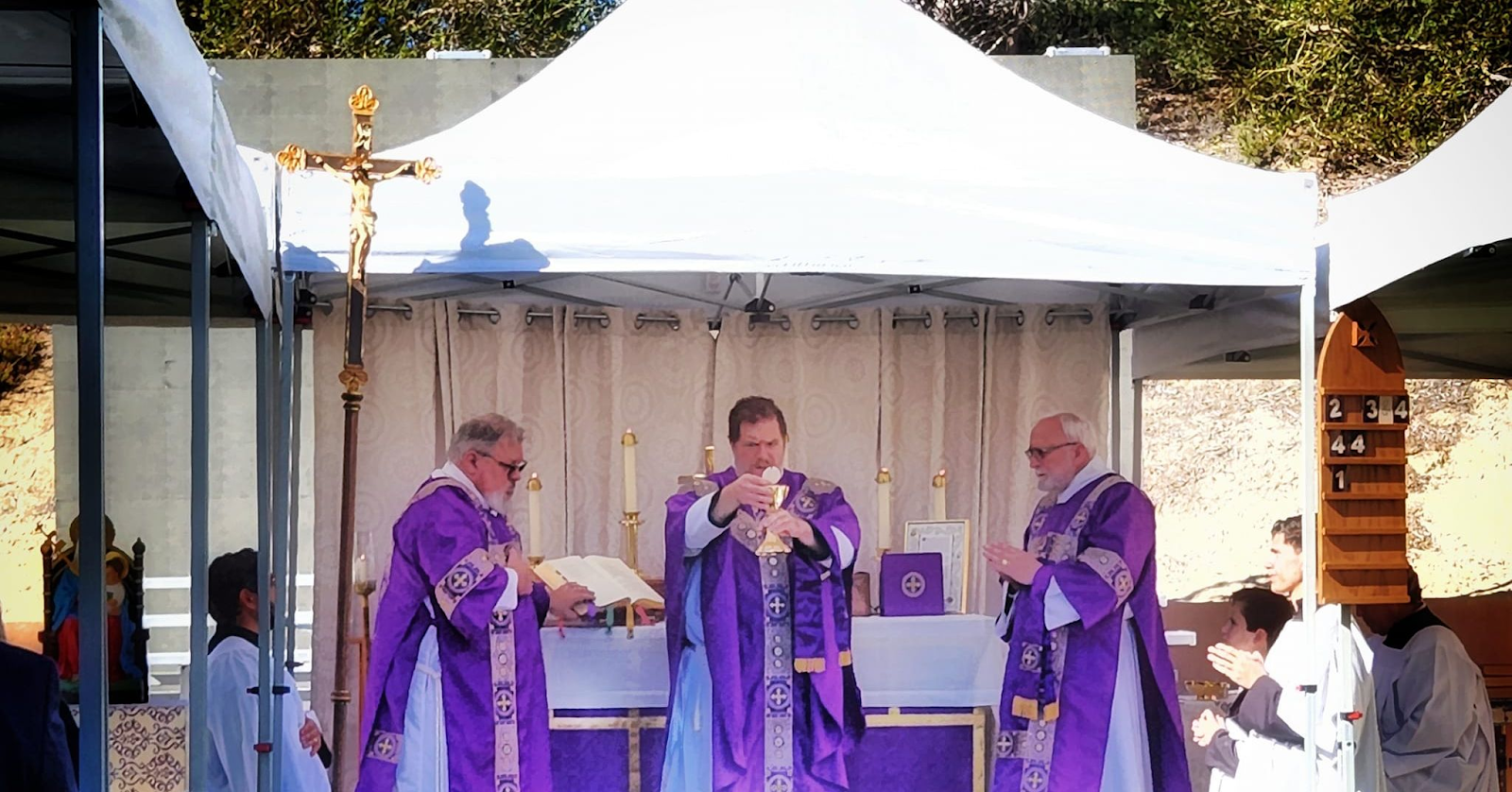
Since Brother Steven Holc directs the choir at the Pala TLM, the chaplain to Pala, Fr. Peter Adrian Miller, O.Praem, was celebrant for Monday night's Solemn High Requiem Mass for Maria Holc. Fr. John Lyons, F.S.S.P. was the deacon for the Mass, and Fr. Earl Eggleston served as subdeacon. Aside from the Brothers and Chorus Breviarii San Diego, those in the loft that night included members of Chorus Breviarii Murrieta, the choir at Holy Martyrs Anglican Ordinariate Parish, and Fr. Eggleston's acolyte schola. The motet during Communion was Jacquet of Mantua's O Jesu Christe. Since the burial was not to take place that day, the Benedictus with antiphon Ego sum was sung between the absolution of the catafalque and the In paradisum. It was the first liturgical service at which newly-admitted Brother Adrian Ople wore his Oratorian collar.


Fr. Eggleston chants the Epistle.

Fr. Lyons chants the Gospel.

Fr. Peter Adrian preaches on the
charity of a mother.


Brother Tom Gray fulfills his usual role
of ringing the bell at the consecration.

The servers and clerics
process to the catafalque.


Monday, January 6, 2025

A White Elephant for D.C.


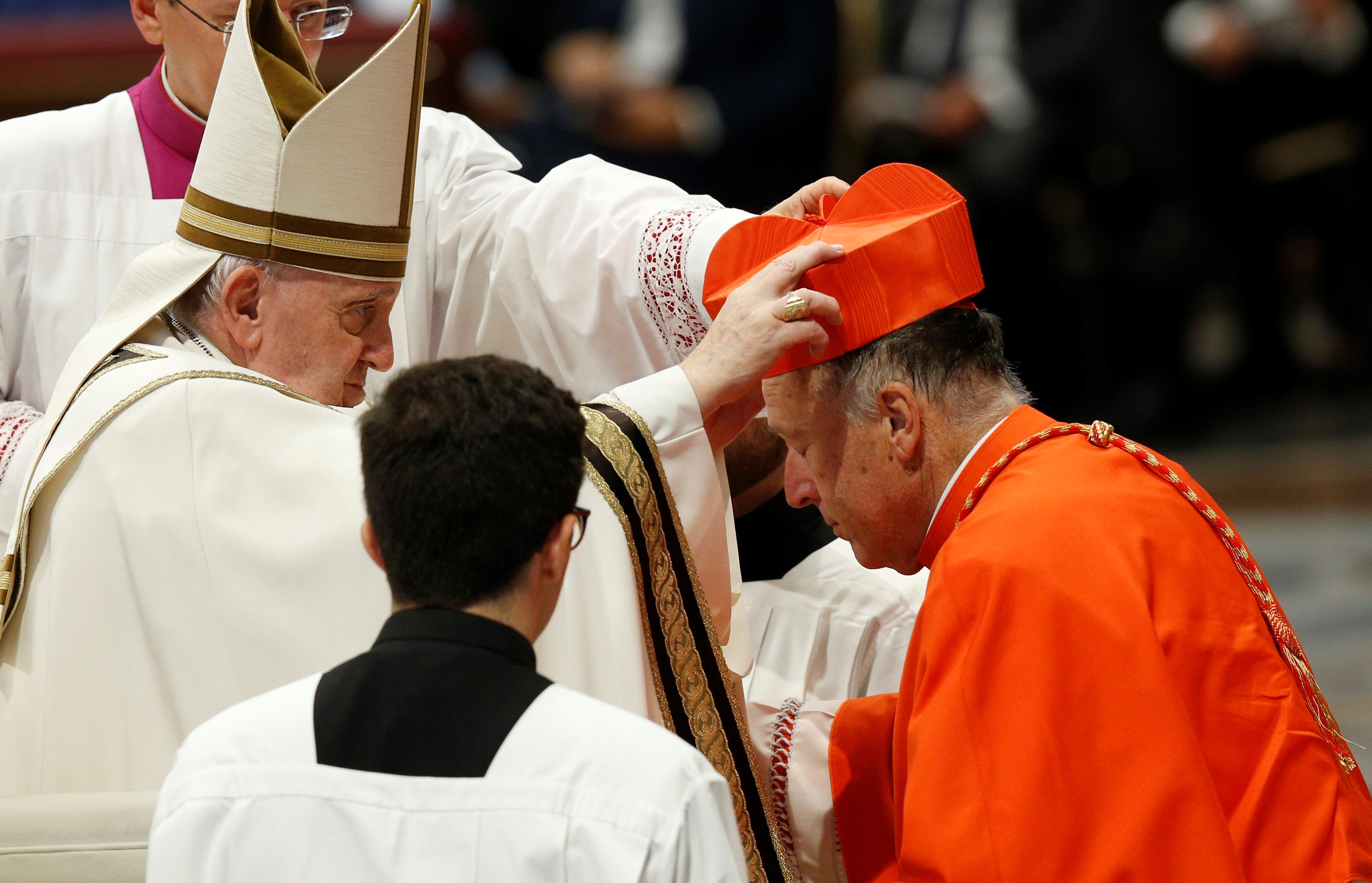
Whether Cardinal McElroy's promotion from the humble Diocese of San Diego to the prestigious Archdiocese of Washington leads to greater liberties for Chorus Breviarii and even better prospects for the foundation of an Oratory in San Diego remains to be seen.


A blessed Epiphany to all, especially the Brothers of the Little Oratory in D.C.

Wednesday, October 16, 2024

Newman as a Local Doctor of the Church

Today is the Octave Day of St. John Henry Newman, father of the Oratory in England. Last Tuesday, on the eve of his feast day, one of our Chorus Breviarii members met with some recently-graduated students of JPCatholic University in Escondido to chant First Vespers in honor of the famous Cardinal who converted to the Church from Anglicanism.

Despite leaving the Church of England for the true Church, the Anglican calendar still commemorates St. John Henry Newman in their liturgical calendar on his dies natalis of August 11, one of the bizarre consequences of the Anglicans shifting their ecumenism into high gear. Since the 1970 General Roman Calendar commemorates St. Clare of Assisi upon August 11, the Catholic commemoration of Cardinal Newman occurs on October 9, the date of his formal reception into the Church. We ourselves have sung the Traditional Mass for this great Oratorian Saint in the past, even when he had just been declared a beatus.

Last year, the United States Conference of Catholic Bishops voted to support the Bishops' Conference of England and Wales in their petition to declare Newman a Doctor of the Church. While the process toward universal recognition as a Doctor moves along, there could be a case for both the Oratorians and the English to honor Cardinal Newman as a Doctor sooner using local calendar permissions. 

While searching for liturgical texts related to the Feast of Our Lady of the Pillar, our poster designer Martin found a PDF of the Supplementum pro Hispaniae Dioecesibus (Supplement for the Dioceses of Spain) published by Solesmes Abbey in 1927. Pages 10 and 11 of the Supplement list St. Fulgentius and St. Leander (San Leandro) as Doctors of the Church, despite not being recognized as such in the universal list of Doctors. A certain edition of the Catholic Encyclopedia mentions that certain Saints, including those eventually made universal Doctors of the Church, were allowed to be celebrated as Doctors in specific localities (e.g., the Venerable Bede in England, St. Fulgentius and St. Leander in Spain) or within specific orders (e.g., St. Peter Damian for the Camaldolese, the Venerable Bede and St. Leander for the Benedictines). 

(See Note 1 for more details).

Considering these past permissions, it would be fitting for the English dioceses and the Oratorians to pursue an indult to celebrate the Feast of St. John Henry Newman as that of a Doctor of the Church, even if he still isn't recognized as such universally. Perhaps even the Personal Ordinariates for former Anglicans could follow suit. Of course, the situation of the traditional Roman Rite being frowned upon by the Vatican combined with a contemporary lack of understanding of how the Breviary and the old Lectionary work would probably complicate the process of pursuing an indult. Cardinal Newman may already be named a Doctor of the Church by the time liturgical freedoms allow for such indults to be pursued easily.

If Cardinal Newman were bestowed the honor of Doctor of the Church, then his Magnificat antiphon variant would probably be as written above, since the Collect for the Memorial of St. John Henry Newman refers to the Saint as "John Henry" in the Latin. If "Henrice" were not to be used, then it would make Cardinal Newman's Magnificat antiphon identical to those of at least three other Doctors of the Church: St. John Damascene, St. John of the Cross, and St. John of Avila (Note 2).

Aside from the use of O Doctor optime at Vespers and the Mass In medio Ecclesiae, Cardinal Newman's feast is observed as that of a Confessor-not-a-Bishop, as despite his elevation to the College of Cardinals, he was never consecrated a bishop (Note 3) For this reason, the booklets we created for Cardinal Newman's Vespers began with the antiphon Domine, quinque talenta rather than Ecce sacerdos magnus. Despite the fact we were chanting Vespers in a living room rather than inside a chapel or in an outdoor setup (as we did in Escondido, El Centro, and the Presidio), we still included processional and recession hymns in our booklets. "Praise to the Holiest in the Height" was used for our entrance, and the Nashotah House version of "Firmly I Believe and Truly", a favorite of our friends in the Ordinariate, was used as the recessional following Compline. "Lead, Kindly Light" was also included in the booklets.

We will continue to pray for the cause to recognize St. John Henry Newman's contributions to the Church. Hopefully we will be able to sing Vespers for a Doctor in his honor someday!


Note 1. These honors are recognized in the Catholic Encyclopedia article "Doctors of the Church" as found on Wikisource (Wikimedia Foundation) and Catholic Answers, but the paragraph mentioning them is absent from the New Advent version. The article as found on Wikisource is labeled as a 1997 edit, and this version is also found on Catholic.org, the Mary Foundation, and e-Catholic 2000, with the Catholic.org version labeling the 1997 edits as "web editor's notes"; even a PDF version of the Encyclopedia found on the Christian Classics Ethereal Library appears to be the 1997 edition. The Catholic Answers version of the article omits the obvious 1997 edits, such as the mentions of John Paul II's selection, but the paragraph mentioning the indults given to Spain and various religious orders is still present. My conjecture is that either Mr. Kevin Knight, editor of the New Advent version of the Encyclopedia; or Mr. Gerard Haffner, who transcribed the article for New Advent, intentionally omitted this final paragraph due to its mention of the number of Doctors of the Church, which would explain a strange gap between the text of the article and the footer not seen on other New Advent articles. For context, the 1997 edit begins the paragraph in question with: "There are therefore now [1997] thirty-three Doctors of the Church," while the Catholic Answers version begins with: "There are therefore now twenty-three Doctors of the Church." Thus, I conclude that the useful information about St. Leander and other Doctors granted by indult was set aside to avoid mentioning a dynamic number that has become controversial in Traditional Catholic circles, whether due to Paul VI's decision to give the honor of Doctor of the Church to women, or due to Francis' elevation of Gregory of Narek. St. Teresa's doctoral qualities have at least been recognized by the Church before Paul VI, with some art of her depicting her wearing an academic biretta.

The peculiar gap

Note 2. Despite St. John Chrysostom being another "John" recognized as a Doctor of the Church, his variant of O Doctor optime uses "Joannes Chrysostome" rather than the generic “Joannes” variant shared by St. John Damascene and St. John of the Cross. The reasoning for this is likely the same that can be found in Foley's "The Name Game of the Orations" published on New Liturgical Movement earlier this year, which elaborates on a footnote found in a work by Fr. Nicholas Gihr. While not explicitly mentioning O Doctor optime, the article also sheds light on why St. Alphonsus' variant of the antiphon uses "Alphonse Maria" rather than just his first name. The use of double names in the orations of St. Alphonsus and St. Margaret Mary therefore justifies the decision to refer to Cardinal Newman as "John Henry" in his version of the antiphon. St. John of the Avila's antiphon is likely identical to those of St. John Damascene and St. John of the Cross since he lacks a double name, but I cannot find an actual transcription of his antiphon due to the difficulty of navigating the Liturgy of the Hours. 

Note 3. The situation of cardinals not made bishops was much more common before Vatican II. John XXIII ruled in 1962 that cardinals without a dispensation must be members of the episcopate, and John Paul II's 1983 Code of Canon Law codified this ruling, slowing the creation of cardinals who are only priests and making the position of "lay cardinal" extinct.

Friday, September 27, 2024

A Recently Painted St. Philip Statuette

During his visit to London around St. Philip's Day this past spring, Frater David Latorre purchased a statuette of St. Philip at the Oratory gift shop. As can be seen in the photo below, it initially came unpainted. As Fratellino pointed out, besides some details in the cassock, this gift shop statuette is a very faithful depiction of St. Philip. Paintwork was done by a friend of Frater Roberto Lionello and his wife Grace.


During our usual conclusion of Monday night practice with Compline, Frater David placed the statuette on the mantle next to the crucifix. This recently painted statuette makes a wonderful addition to the Brothers' devotional objects, and it was recommended to the San Diego Brothers' current postulants that they themselves should obtain something similar during their visit to London for admissions.


(Courtesy: David)

Monday, September 2, 2024

Monday, Sep. 9: Office of the Dead for John J. Velasco

The old service-books of the English Church (1904) (14774904271)
Prayer Book Brt. Mus. MS. Harl. 2915.

Monday, September 9, 19:30 ( 7:30 P.M.)
Office of the Dead  
in the Traditional Roman Rite
 for the Repose of the Soul of John J. Velasco

Hebdomadary: Rev. Fr. Jesus Valenzuela, F.S.S.P. (for Vespers)


Please join us next Monday night at St. Anne to pray the Hours of the 
Office for the Dead for the repose of our Brother John J. Velasco, who passed away two years ago. The Hours will consist of Vespers, a single nocturn of Matins (Nocturn II), and Lauds. Vespers will start after the 6:30 p.m. Mass at St. Anne. The full set of hours should end about 9:00 p.m. Come hear the words of King David, King Hezekiah, and the righteous man Job that touch on the reality of death, suffering, and hellfire, as well as our hope in the resurrection promised to us by our Lord in the Magnificat and the Benedictus.

Wednesday, May 8, 2024

Throwback to a 2008 San Diego Brother

Those who keep up with New Liturgical Movement may have seen that our Brother Robert Keim has been welcomed as a new member of NLM's writing staff. Congratulations to him!

Frater Robert was part of the group of Brothers admitted to the Oratory in 2008, the others being the late John J. Velasco, his son Christopher, Wayne Lam, Richard Dawes, and George Pecoraro. 

Frater Robert reading from
Fr. Bacci's life of St. Philip in a
 Precious Blood robe.

It seems that all our articles that mention him are nearly 15 years old or older! There are some great photos included, so we encourage you to take a look.
Additionally, Frater Robert accompanied Fratellino and Frater Richard to sing for a Solemn High Mass in Orange County over a decade ago.

St. John the Evangelist, Costa Mesa, 2013

For those interested in Mr. Keim's first few articles from New Liturgical Movement, we have them linked below.

Additionally, he is one of the twenty-six authors included in Dr. Peter Kwasniewski's book Ultramontanism and Tradition: The Role of Papal Authority in the Catholic Faith, with some of the other authors including Cardinal Burke, Bishop Schneider, and Dr. Joseph Shaw of the Latin Mass Society, as well as fellow Southern Californians Dr. Ed Feser and Charles A. Coulombe. Dr. Kwasniewski has information on the book here.

Wednesday, February 28, 2024

The Little Oratory, Can't Vote

Image of St. Philip posted by Marlon.
Probably from the Pharr Oratory.

The Manual of the Little Oratory, the websites of various Oratories around the United States, and the Constitutions of the Oratory make it clear that voting is a normal aspect of Oratorian life. I realized recently that it was a bit ironic that the newest Oratory of Pontifical Right to be established is located in Washington, D.C., a part of the United States well-known for its inability to vote for Congressional representatives in the House or Senate (thankfully). In a discussion I had with Fratellino about what the acrostic for the D.C. Oratory's version of "True Sons of Philip" should spell out, I suggested The Little Oratory, Columbia. On the other hand, Fratellino suggested the much more humourous The Little Oratory, Can't Vote. Taking Fratellino's concept, here is one suggestion.

True sons of Philip, raise

Heav’nward your strain of praise,

Ever rejoicing in God, as he taught;

Learn from St Philip still

In body, mind and will

Truly our Lord to serve, counting self as naught.

Songs therefore let us bring,

Praises to Jesus sing,

Now and for ever our Lord and our God. (2)

Trust in St Philip’s prayers,

Let him relieve our cares,

Ease for us gain in temptation and stress.

Once we his aid invoke

Riven is Satan’s yoke

And we are stronger our Saviour to bless.

(Refrain)

Turn, as St Philip bade,

Often to Mary’s aid,

Refuge and help she refuses to none;

Years have not dimmed her power

Come now and ev’ry hour

All grace she wins us by prayer with her Son.

(Refrain)

Never shall we despair

Triumphant, we declare

Victory over sin with the Spirit's love;

Out with all sadness here,

Take on St. Philip’s cheer

Evermore till we rule with the Saints above!

(Refrain)


The lines for "C" and "A" in the third verse are identical to the Cardiff Oratory's acrostic, while the "O" in the final verse is identical to the one found in Oxford's acrostic. We here in San Diego certainly look forward to whatever D.C. decides to write for their version of this great Oratorian hymn, but I hope they enjoy our rendition as well!

As the Cardiff Oratory explains, the hymn was originally written as an acrostic, spelling out The Little Oratory in London. Adaptations for each Oratorian House in Britain modify the last eight lines of the song (i.e., the last third of the third verse and the whole six lines of the fourth verse). The refrain acrostic spells out S.P.N. (St. Philip Neri). 

At Cardiff, these last eight lines spell out Caerdydd (the Welsh name for the city), while Oxford's lines spell out in Oxford. The verse-writer at Oxford dealt with the difficulty of the letter "X" by referring to St. Francis Xavier, one of St. Philip's role models (as well as one of the four Spaniards he shares his canonization date with). Since the Brothers in San Diego were received into St. Philip's family at London, Chorus Breviarii is accustomed to singing the original in London version. However, somewhere in Fratellino's archives, there may still exist a copy of an acrostic for San Diego written over a decade ago. 


Now, we ought to charge Marlon with writing one for Pharr if they develop a sizeable Little Oratory out in Texas.

Friday, February 23, 2024

Valē, Marlōnī

Marlon serving Mass at St. Augustine of Canterbury (right)

One of our young Chorus Breviarii members from the Imperial Valley, Marlon Munguia, will be starting a period of discernment at the Pharr Oratory in March. We pray that his postulancy will be fruitful and that the Fathers in Texas will find him well-suited for the Oratorian life. 

Marlon graduated from JPCatholic University in Escondido in 2023. During his time as a student, he led the school's Divine Office Ministry (now called Pelicanes Traditiones) and even attended some classes taught by Fratellino. Through his involvement in promoting the Traditional Divine Office at JPCatholic, the Brothers have been able to celebrate Vespers for and with the students. JPCatholic students have also been able to attend our Tenebrae services through carpools organized through the ministry. We hope that we will continue to see them attending or serving at our events.

Frater Ron's picture of Marlon serving as thurifer

Up until Fr. Samuel Keyes' departure from San Diego to a new assignment in Connecticut, Marlon also served at Holy Mass with Frater Ron Clemente at the Ordinariate Parish of St. Augustine of Canterbury.

Before becoming a Chorus Breviarii member in 2021, Marlon and his group of friends were active in trying to promote the Traditional Mass and Divine Office in the Imperial Valley. This was the cause of our visit to celebrate Sunday Vespers in El Centro in September 2021. We hope that his friends will continue to promote these sacred and ancient rites, and we may pay a visit again if time permits. 

We will certainly miss Marlon for Tenebrae this year. However, if God wills it, we may see him again with the Oratorian collar! May St. Philip pray for him!

Sunday, February 18, 2024

Congrats to the D.C. Oratory

The Brothers of the Little Oratory in San Diego (and Chorus Breviarii) would like to extend our congratulations to the D.C. Oratory for their formal establishment on the Feast of Candlemas, 2024. Our very own Fratellino paid a visit to D.C. in June of 2021 while they were still an Oratory-in-Formation. Below is a video message sent to us from Msgr. Wadsworth during Fratellino's visit. May Good St. Philip continue to intercede for them as they labour in our nation's capital.


Fratellino's hat at the D.C. Lady Altar

Tuesday, October 31, 2023

For Friends, Relations, and Benefactors

The month of November, and especially the Octave of All Saints, is dedicated to prayer for the souls suffering in Purgatory. Please pray for our deceased brethren, friends, and benefactors, as well as for the deceased relatives of our members and benefactors still living. We have included some below.

  • Fr. Harry Neely, O.S.A. (+2020), chaplain to the Holy Cross TLM
  • Fr. Reginald "Rex" DeFour, C.S.Sp. (+2021), chaplain to the Holy Cross TLM
  • Fr. Louis Mary Solcia, C.R.S.P. (+2023), beloved priest of San Diego's Little Italy
  • Frater John James Velasco (+2022), a San Diego Brother of the Little Oratory
  • Jon Roussos (+2022), a Chorus Breviarii member, friend of the Byzantines and Ordinariate
  • John M. Polhamus (+2022), father of Frater John B. Polhamus
  • Romualdo G. Clemente (+1989), father of Frater Ron Clemente
  • Adelaida C. Clemente (+2023), mother of Frater Ron Clemente
  • Raleigh S. Clemente (+2022), brother of Frater Ron Clemente
  • Angelina Albor (+2023), great aunt of Fr. Raymond Philip Napuli
  • Hank Goldmann (+2023), father-in-law of Brian Donnelly of C.B. Murrieta
  • Peter Vincent Leparulo (+2015), a supporter of the Brothers in San Diego

  • Joseph Shaara (+2023), a Holy Cross member, for whom we sang a Requiem for last month
And for all others who we have not named here, especially for the deceased Fathers of the London Oratory, and for our brethren in London, may they and the souls of all the faithful departed, through the mercy of God, rest in peace.


Courtesy: Fratellino

Wednesday, September 20, 2023

Lenten Exercise Paralipomena

In a prior article, we discussed the Exercises proper to the Brothers during the summer. Since it is now the penitential Ember Week of September, this article will return to discussing the Lenten Exercises and how we concluded with them this year. Our previous article on the Lenten Exercises can be found here

Chorus Breviarii Murrieta at Mass
Murrieta Visits

On March 17, Chorus Breviarii Murrieta and others came down to San Diego as part of a Mission Pilgrimage in honor of St. Junipero Serra. Gabriel Palencia has a write-up on the purpose of the pilgrimage available on the Chorus Breviarii Murrieta blog. After attending Mass and praying the Stations of the Cross, these pilgrims prayed the rosary in the Mission courtyard in front of the statue of Fr. Serra, concluding with various hymns.

The Pilgrimage Flyer

After some hesitancy over what the pilgrims would have for dinner, followed by a failed attempt at getting a table at another restaurant, they settled on a nearby IHOP location. Despite being a "24-hour location," this location was just about to close because one of the cooks was feeling a bit under the weather. Nonetheless, they were able to secure their breakfast-for-dinner while enjoying a good few laughs around the table over various jokes.

After an exchange of goodbyes amongst themselves in the IHOP parking lot, some of the pilgrims concluded their visit by joining the Brothers for Friday Exercises at St. Anne. The Brothers were delighted by their presence, and they were all excited for the upcoming Tenebrae services.

Saturday Stations in Spanish

Lauds of the Dead at the Mission

Some affiliates of Chorus Breviarii paid another visit to the mission the following day as part of a pilgrimage in honor of the Martyrs of the Spanish Civil War, as well as for the general needs of the children of the Spanish Empire. After attending the morning Low Mass and receiving a blessing from one of the priests at St. Anne, the pilgrims made their way to Mission San Diego to pray the Stations of the Cross according to an early 20th-century Spanish translation. The Most Holy Rosary followed the Stations.

The Pilgrimage Flyer

After the Rosary, Chorus Breviarii members led Lauds of the Dead for the repose of the souls of those killed in the Spanish Civil War who were not listed among the martyrs. It had probably been decades since even laymen had sung the Office of the Dead in the old mission church, so it was certainly an opportunity to feel united to the traditional expressions of the faith that had long been neglected. Following the conclusion of Lauds, the pilgrims chanted the noon Angelus and exited the church into one of the courtyards. A couple that had been visiting the mission asked the pilgrims what they had been singing, saying that it sounded beautiful. The pilgrims both explained what it was and why they were praying these things at the mission, especially emphasizing the importance of the Office of the Dead to pray for the departed souls.

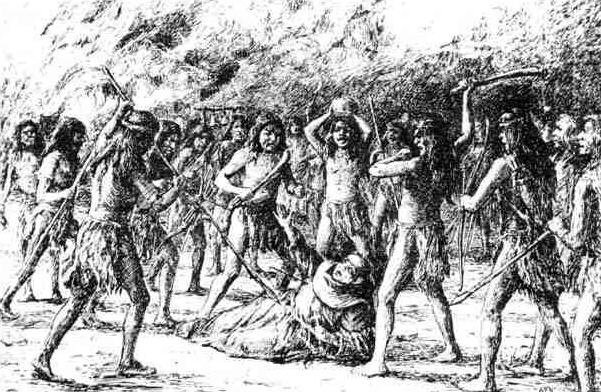
The humble St. Junipero Serra likely prayed these same Hours for the Dead after his fellow Majorcan Franciscan, Father Luis Jayme, was brutally killed at the hands of the Kumeyaay Indians following the burning of Mission San Diego in 1775. Father Jayme is now buried under the sanctuary of the current mission, and it would be profitable to pray for his future canonization as Protomartyr of California. 

When the Kumeyaay came with their clubs, stones, and
arrows, Father Luis Jayme greeted them with the
traditional Franciscan invitation to love God.

As Father Luis Jayme was martyred at the hands of enraged native warriors for conducting his ministry, so was an Oratorian on the path to sainthood martyred at the hands of cruel soldiers during the Spanish Civil War. The Blessed Salvio Huix Miralpéix, Cong. Orat., was Bishop of Lleida in Spain when he was imprisoned by the Spanish leftists along with other priests and laymen. During his time in prison, he continued to provide the sacraments, and when the leftists decided it was time for the good bishop to die, they brought him out to the cemetery so that he would dig his own grave. The leftist soldiers tried to make the Blessed Salvio renounce the faith to save his earthly life, but the bishop refused, instead choosing to be the last to die among the prisoners so that he could bless each one. Despite having his right arm shot by one of the soldiers to interrupt the blessings, the bishop continued with his left arm until the soldiers finally shot him in the head. Father Luis, Blessed Salvio, and the Martyrs of both the Spanish Civil War and the Cristero Wars serve as great examples for Catholics today to stand strong in the face of persecution by earthly powers.

Blessed Salvio Huix, an Oratorian


In Passiontide

The Brothers' last set of exercises was prayed on the Friday in Passion Week (also called the Friday of Sorrows), and thus, the illuminated crucifix was veiled in the violet cloths specific to Passiontide. The darkness of Friday Exercises was made more apparent by the hiding of the figure of Our Lord, the Light of the World, from the eyes of those praying before the Cross. At the conclusion of Exercises, the Brothers were now only five days away from the beginning of Tenebrae.


Photos and Flyers: Gabriel, Martin
Art Courtesy: Unknown artists

  • The sketch of the martyrdom Fr. Jayme is from The Journal of San Diego History via Wikipedia.
  • The portrait of Blessed Salvio Huix, C.O., was obtained via the Birmingham Oratory

Saturday, February 25, 2023

St. Philip, Bad Confessors, and the Devil

The Church of St. Mark in Florence

In the first chapter of Book One of The Life of St. Philip Neri, Apostle of Rome, Fr. Bacci speaks of St. Philip's frequent visits to the Dominican Church of St. Mark during his boyhood in Florence. This is the same St. Mark's that housed the famous friars Fra Angelico and Savonarola, the latter of whom St. Philip admired and defended. While these two great Dominicans died before St. Philip's birth, St. Philip was familiar with two other Dominicans, Fra Zenobio de' Medici and Fra Servanzio Mini. Testifying to their virtue, Philip often recalled the following event to his disciples:

St. Benedict expelling the devil, from the sacristy of San Miniato in Florence (1388)
Spinello Aretino (Tuscan, c. 1350 - c. 1410)

These two fathers had agreed together to hear each other’s confessions every night, before they went to matins, in order that they might say office with greater devotion; but the devil was envious of so much good, and one night, about two hours before the usual time, he knocked at the cell of Fra. Zenobio, saying, “Up quickly, it is time.” At these words the good father woke and got up, and went as usual into the Church, where he found the devil in the form of Fra. Servanzio, walking near the confessional. Believing it was really his companion, he knelt down to confess, and the devil sat down as if to hear the confession, and at each fault which Fra. Zenobio named, he cried out, “It is nothing, it is nothing.” At last the friar adding a fault which seemed to him of a somewhat more grave character, the devil still said, “It is nothing.” When Zenobio heard this form of speech, he bethought himself a little, and suspecting, not without reason, some diabolical illusion, he at once made the sign of the holy cross, saying, “Perhaps you are a devil from hell,” at which words the evil spirit was confounded, and immediately disappeared.

Sacrament of Penance (c. 1800)
Francesco Novelli (Italian print, 1764-1836)
The devil attempts to prevent a woman from making a good Confession

In the present day, many penitents are often subjected to dangerously soft confessors who attempt to minimize sins. Some priests laugh mortal sins off as "common" or even allude to their own faults in a light-hearted manner. Other priests attempt psychologizing sins of imprudence and impurity, and some may even accuse young men of being too hard on themselves. When it comes to being good confessors, can these priests claim to be that much better than the devil himself when he tested Fra Zenobio? The devil does not need to tempt us with the promise of dominion over earthly kingdoms to gain our servitude, as he did during the unsuccessful temptation of Our Lord in the wilderness. Rather, that simple lie repeated by the Devil under the appearance of Fra Servanzio is enough to rope many into Hell: "It is nothing." Many Americans have been deceived by the false Gospel of "once saved, always saved," even believing continuous repentance to be useless. Meanwhile, many Catholics have been tricked by Protestants and crypto-Protestants into denying the power of Penance, often quoting erroneously from Scripture. The Gospel of the First Sunday of Lent reminds us that even the devil can deceive us with Scripture. Whether the devil chooses to attack the faithful with bad advice in the confessional, bad preaching from the pulpit, or bad YouTube videos promising eternal security, Catholics must remain firm against falsehood and error. Follow the example of Christ in the wilderness this Lent, and you will be rewarded for resisting temptation!

The Temptation of Christ on the Mountain (c. 1308-1311)
Duccio di Buoninsegna (Italo-Byzantine, Sienese, c. 1255 - c. 1318)